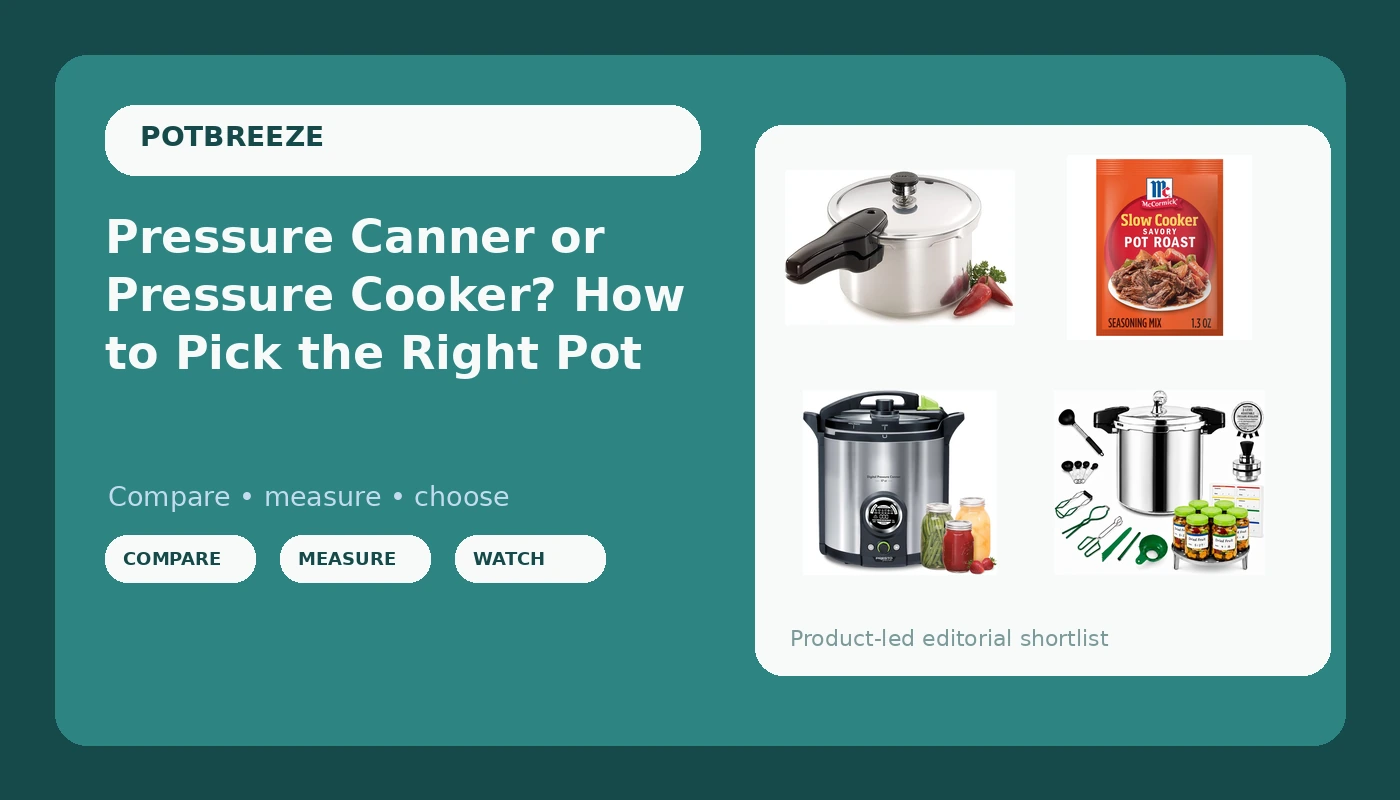
Walk down the cookware aisle and a pressure canner and a pressure cooker look like cousins: heavy lidded pots, a gasket, a vent, and a promise of faster cooking. The pressure canner vs pressure cooker question gets confusing because both run on the same physics, and because a few products blur the line on purpose. They are built for two different jobs, and the difference shows up the moment you try to use one for the other.
The short version: a cooker is a weeknight tool, and a canner is a preservation tool. Buy a canner to make chili and you own a very large, very heavy pot that takes a long time to come up to pressure and a long time to cool down. Buy a small cooker to put up tomatoes and you own something that cannot do that job safely. This guide covers four options that sit on both sides of that line, plus the checks that matter before you spend money.
Related: Stovetop vs Electric Pressure Cookers: Which One Fits Your Kitchen →
Quick answer
A pressure cooker is for cooking food fast in a sealed pot. A pressure canner is for processing sealed jars at a regulated pressure so low-acid food keeps on a shelf. If your goal is dinner on a Tuesday, buy the cooker. If your goal is pantry shelves in September, buy the canner. The two are not interchangeable, and a standard electric multi-cooker is not a substitute for a canner that was designed and tested for jar processing.
Four useful options
| Model | Best fit | What stands out |
|---|---|---|
| Presto 02152 17-Quart Digital Pressure Canner | Large-batch canning with digital control | 17-quart capacity with a digital control setup instead of a dial gauge |
| 24QT Pressure Canner, 11-Piece Kit, Gas & Induction, 5/10/15 PSI Regulator | High-volume canning on gas or induction | The largest body here at 24 quarts, sold as an 11-piece kit with a three-setting regulator |
| Presto 01241 4-Quart Aluminum Pressure Cooker | Small weeknight batches on a stove | A 4-quart aluminum stovetop cooker, the simplest and most compact option in this group |
| McCormick, Slow Cooker Savory Pot Roast Seasoning Mix, 1.3 Oz (Pack of 1) | Fast flavor on pot roast night | A single 1.3-ounce packet built around a savory pot roast profile |
The large-batch canner: Presto 02152 17-Quart Digital Pressure Canner
The trade-off with any large canner is counter and storage space. A 17-quart body is a serious footprint, and it is not the pot you reach for when you want two quarts of beans on a Wednesday. What you get in return is the ability to process a full batch in one run instead of three, which matters more than most people expect. Canning is a long process even when everything goes smoothly, and repeating it three times in an evening is how people give up on canning entirely.
The high-volume kit: 24QT Pressure Canner, 11-Piece Kit, Gas & Induction, 5/10/15 PSI Regulator
The three-setting regulator is the detail that earns its keep. Canning guidance ties the pressure you need to your altitude, so a canner that lets you step up from a low setting to a high one is easier to match to your location than a fixed-weight unit. That does not make it automatic: you still have to know your altitude and follow tested processing times for the food in the jar. It just means you are not stuck with one pressure and a workaround.
The stovetop starter: Presto 01241 4-Quart Aluminum Pressure Cooker
Stovetop cooking is a skill, and it is worth saying plainly. You are managing heat, watching a pressure indicator, and deciding when to let pressure fall on its own versus releasing it. That learning curve is real, and it is the reason a lot of people start with a small cooker before committing to a bigger one. A 4-quart pot also has a limit: it is a two-to-three-person batch size, not a meal-prep machine for a crowd.
The flavor shortcut: McCormick, Slow Cooker Savory Pot Roast Seasoning Mix, 1.3 Oz (Pack of 1)
Here is the honest case for a packet: browning a chuck roast and building a braise from scratch is better, and it also takes twenty extra minutes and a spice rack. A seasoning mix is what makes the difference between cooking the roast and ordering dinner instead. The label is written for a slow cooker, so treat it as a starting point and season to taste if you are adapting it to a pressure cooker, where the liquid does not reduce the way it does over six hours on low.
Prices and availability may change. Product names, images, and retailer links are matched to the specific models described here, and nothing in this article should be read as a measured test result.
How a canner and a cooker actually differ
Both appliances raise the boiling point of water by holding pressure inside a sealed vessel. That shared principle is where the similarity ends. A cooker is designed around food: you fill it partway, seal it, bring it to pressure, cook for minutes rather than hours, and then release. A canner is designed around jars: you load sealed jars on a rack, bring the vessel to a specific pressure, hold it there for a tested processing time, and then let it come down slowly enough that the jars do not lose their seal or their contents.
That difference is why a canner is bigger and heavier. Jars need to sit above the water on a rack, with enough headroom for steam to move around them, which is why capacity is measured in quarts and why the 17-quart and 24-quart options here dwarf a 4-quart cooker. It is also why a small cooker cannot be pressed into canning service. Low-acid foods such as green beans, carrots, and plain meats need pressure processing at a regulated level for a set time, and a cooker that only reaches pressure and holds it loosely is not the same tool.
If preserving is your goal, the useful distinction is not which canner is biggest. It is whether the unit gives you a pressure setting you can match to your altitude and a body large enough to process a realistic batch in one run.
What to check before you buy
- Decide which job you are actually buying for. If you have never canned and have no garden or bulk produce source, a cooker will get used and a canner may not.
- Measure your storage space and your stovetop. A 24-quart canner needs a burner and a cabinet that can take it, and it needs headroom under the hood.
- Confirm your cooktop compatibility. The 24-quart kit is listed for gas and induction, which is a specific claim worth checking against your own range rather than assuming.
- Know your altitude. Pressure requirements change with elevation, and a regulator with 5, 10, and 15 PSI settings gives you room to match it.
- Check that the gasket can be replaced. The sealing ring is the part that wears out first and holds on to odors, and a cooker whose ring cannot be bought separately has a short life.
Practical guidance for either path
- Cook dinner in the cooker at least three times before you judge it. Pressure cooking rewards timing discipline, and the first batch is usually the learning batch.
- Let pressure fall on its own for braises and tough cuts. Quick releasing a pot roast is how you get a tough pot roast.
- Keep the sealing ring clean and dry, and replace it when it stiffens or smells. A ring that no longer seals will not hold pressure, no matter how good the rest of the pot is.
- For canning, follow tested processing times and pressures for the specific food, and adjust for altitude rather than shortening the time.
- Do not use a standard electric multi-cooker as a canner. Capacity and pressure regulation are different jobs, and the appliance was not built for jars.
- Start with a small batch in a new canner so you learn the come-up and cool-down rhythm before you commit a full harvest to it.
Which option should you choose?
Choose the Presto 02152 17-Quart Digital Pressure Canner when you want a dedicated canner with digital controls and a capacity that handles a full batch without a second run. Choose the 24QT Pressure Canner, 11-Piece Kit, Gas & Induction, 5/10/15 PSI Regulator when you want the largest body in this group, the accessories included, and a regulator you can step through three pressure settings, and when your cooktop matches what it is listed for. Choose the Presto 01241 4-Quart Aluminum Pressure Cooker when your goal is weeknight dinners for a small household and you want the simplest, most compact way to start. Add the McCormick, Slow Cooker Savory Pot Roast Seasoning Mix, 1.3 Oz (Pack of 1) when you want pot roast flavor without building the braise from scratch.
Two caveats worth stating plainly. First, capacity numbers describe the vessel, not the yield, and the number of jars a canner holds depends on jar size and how they are packed. Second, none of the options here is automatically the right one for your kitchen; the canner versus cooker decision comes first, and the model decision comes second.
The bottom line
If you are cooking dinner, buy a cooker. If you are putting food by, buy a canner. The 4-quart stovetop cooker is the low-commitment entry point on the cooking side, the 17-quart digital canner is the straightforward choice for batch preserving, and the 24-quart kit is for the cook who wants the biggest body and a regulator with settings to match their altitude. A seasoning packet is not a strategy, but it is a fair shortcut on a night when the alternative is takeout. Pick the job first, then pick the pot, and check the sealing ring supply before you commit.